
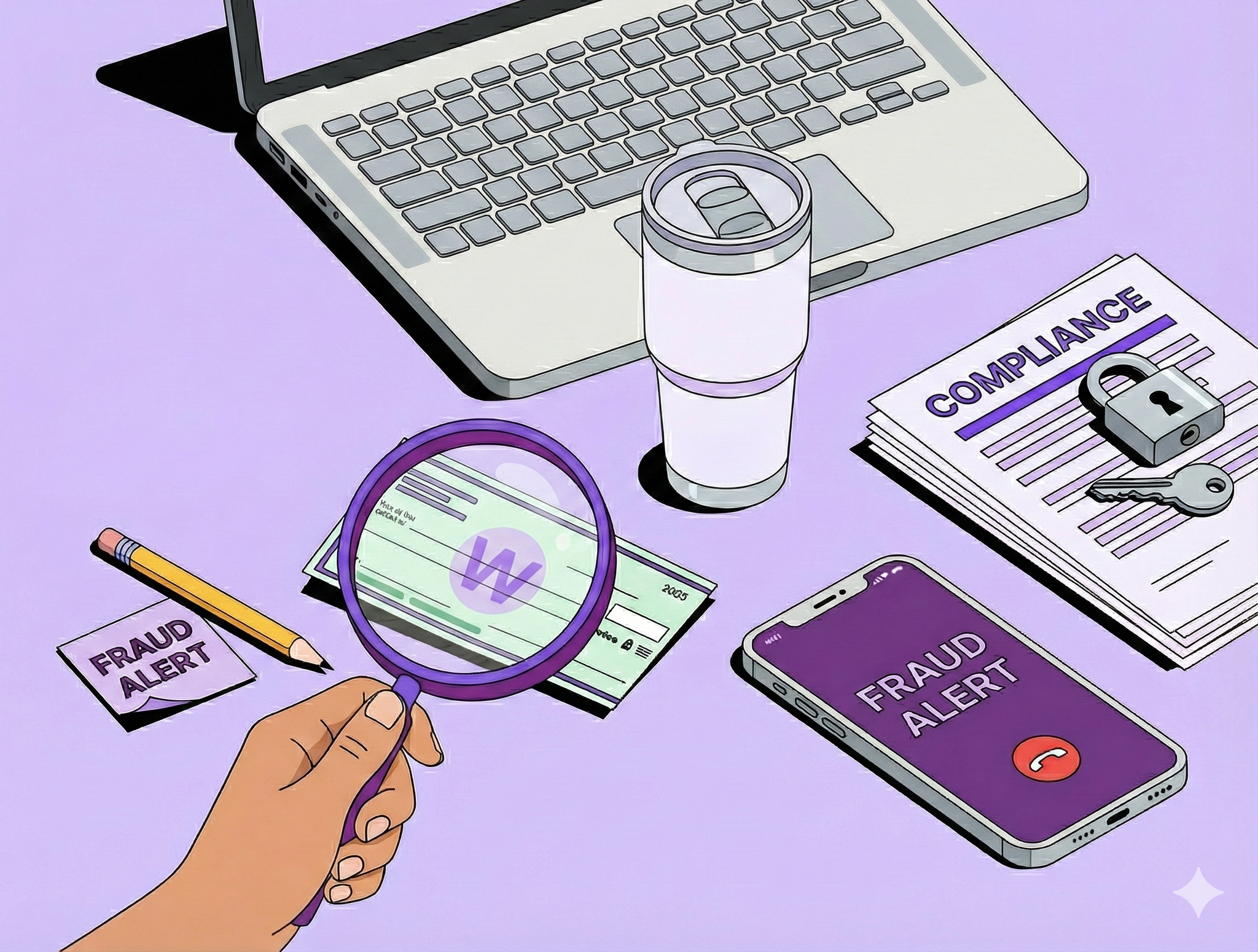
Check fraud is on the rise, and businesses processing high volumes of checks need fast, reliable ways to identify red flags. Whether you operate a check-cashing business, financial service center, or simply want to protect your organization, these 10 expert-backed tips will help you verify checks with confidence.
1. Review the Check for Spelling and Punctuation Errors
Legitimate checks rarely contain typos. Look closely at the check's printed text, including the bank name, address, and payee information. Misspellings, inconsistent fonts, blurry text, or grammatical errors are common signs of counterfeit checks.
2. Ensure the Account Holder's Information Is Professionally Preprinted
In a real check, the account holder's name and address should be professionally preprinted in the upper-left corner—never handwritten, stamped, or added using low-quality printing. Poor printing quality is a major fraud indicator.
3. Check the Check Number and MICR Line for Consistency
Fraudulent checks often use very low check numbers. As a rule: Check numbers should generally be above 100. The check number printed in the top right corner must match the number in the MICR line at the bottom. On business checks, the MICR check number is usually the first group of digits. On personal checks, it's typically the last group. Any mismatch is a red flag.
4. Look for Perforated Edges
Authentic checks typically have perforations on at least one edge. If a check has four perfectly smooth, cut edges, it could indicate it was printed on a home or office printer—one of the most common methods criminals use.
5. Verify the Bank Logo and Bank Information
The bank logo should be: Clean, clear, and professionally printed; Spelled correctly; Accompanied by a valid bank address. Low-resolution logos, incorrect bank names, or missing bank details are strong indicators of fraud.
6. Compare the Numeric and Written Amounts
The dollar amount printed in numbers must match the written-out amount on the line below it. Any discrepancy—even small—invalidates the check and often signals intentional fraud.
7. Confirm the Routing Number's Federal Reserve District
Routing numbers are not random. The first two digits represent the Federal Reserve District where the bank is located. For example: A routing number starting with 05 falls within the district that includes Virginia. If the routing number's district does not match the bank's geographic location, the check may be fraudulent.
8. Match the Fractional Routing Number to the MICR Routing Number
Checks include a fractional routing number—typically a small fraction printed near the top right. The numerator corresponds to digits 1–4 of the MICR routing number (dropping leading zeros). The denominator corresponds to digits 5–8 of the MICR routing number (again dropping leading zeros). Example: MICR routing digits 0520 become 520. The denominator 0042 becomes 42. If these fractions do not align with the MICR routing number, treat the check as suspicious.
9. Inspect the Check's Security Features
Legitimate checks include multiple security features such as: Watermarks, Microprinting, Heat-sensitive ink, Security threads, Holograms, "Do Not Accept Without Verification" banners. Turn the check over and look for a description of the security features included. If these features are missing or look cheap, it's a warning sign.
10. Always Check the Back for a Security Feature Explanation
On the reverse side of most authentic checks, you'll find a description of the built-in security features. If this explanation is missing, vague, or appears poorly printed, the check may be counterfeit.
Detecting fraudulent checks doesn't require special equipment—just proper training and consistent review. Use these ten tips to strengthen your fraud prevention workflow, protect your business, and reduce risk.
© 2026 LytCheck. All rights reserved.